
Somervell 72-Hour Release Access
No official Somervell County Sheriff 72-hour release page or downloadable list was found. The official site also provides no live roster, archive, known feed schema, refresh schedule, or booking-photo field. This is not a hidden extension of a one-day view. Neither a one-day nor three-day official feed exists.
The Somervell County Sheriff page says the agency lacks electronic viewing capability for requesters and supplies copies for viewing. That local rule makes the retained jail register and release documents the proper source. A site with a government-like name should not be called a sheriff mirror unless its origin, timestamps, and correction process are proven.
The official sheriff source captures the county's direct-access limitation.
Its access statement supports a copy request, not a claim that an online three-day archive is available.
Define Somervell's Three-Day Window
“Last 72 hours” must have fixed endpoints. A request sent on Monday afternoon could otherwise be read as three calendar dates, three business days, or the prior weekend. State the start and end date, exact time, and Central Time. Ask whether the produced entries use the actual departure timestamp, the time staff entered the event, or the report date. Those fields can differ.
- Choose a continuous 72-hour interval with a start and end timestamp.
- Request existing jail-register or release-log entries falling in that interval.
- Ask for release or transfer date and time, disposition, authority, cause number, and recorded destination.
- Request corrections or version information if the output came from a jail-management export.
- Compare each result with the related court case and successor custody system.
The county open-records route accepts written law-enforcement requests. The sheriff's contact point is 750 E. Gibbs Boulevard, Glen Rose, TX 76043, phone 254-897-2242, and fax 254-897-9414. Requests may be submitted through the official email route or delivered during normal business hours. Government Code Chapter 552 applies to existing records and does not require the office to create a new database.
Ask for the records in the form already maintained. A three-day interval may return separate register entries, booking-out documents, or release authorizations instead of one polished table. If the sheriff cannot produce the requested arrangement without new programming, accept the native form or reduce the fields. No sourced Somervell fee applies automatically to this request. Charges depend on the responsive copies and work allowed under the Texas rules, so review any written estimate before authorizing a broad production.
A precise request can also address revisions. Ask whether a later correction changed the release time, destination, or disposition during the chosen interval. Preserve the date on which the record was supplied. That makes it possible to distinguish a corrected official entry from an old screenshot or commercial copy that was never updated.
The request source shows where a defined three-day inquiry should be sent.
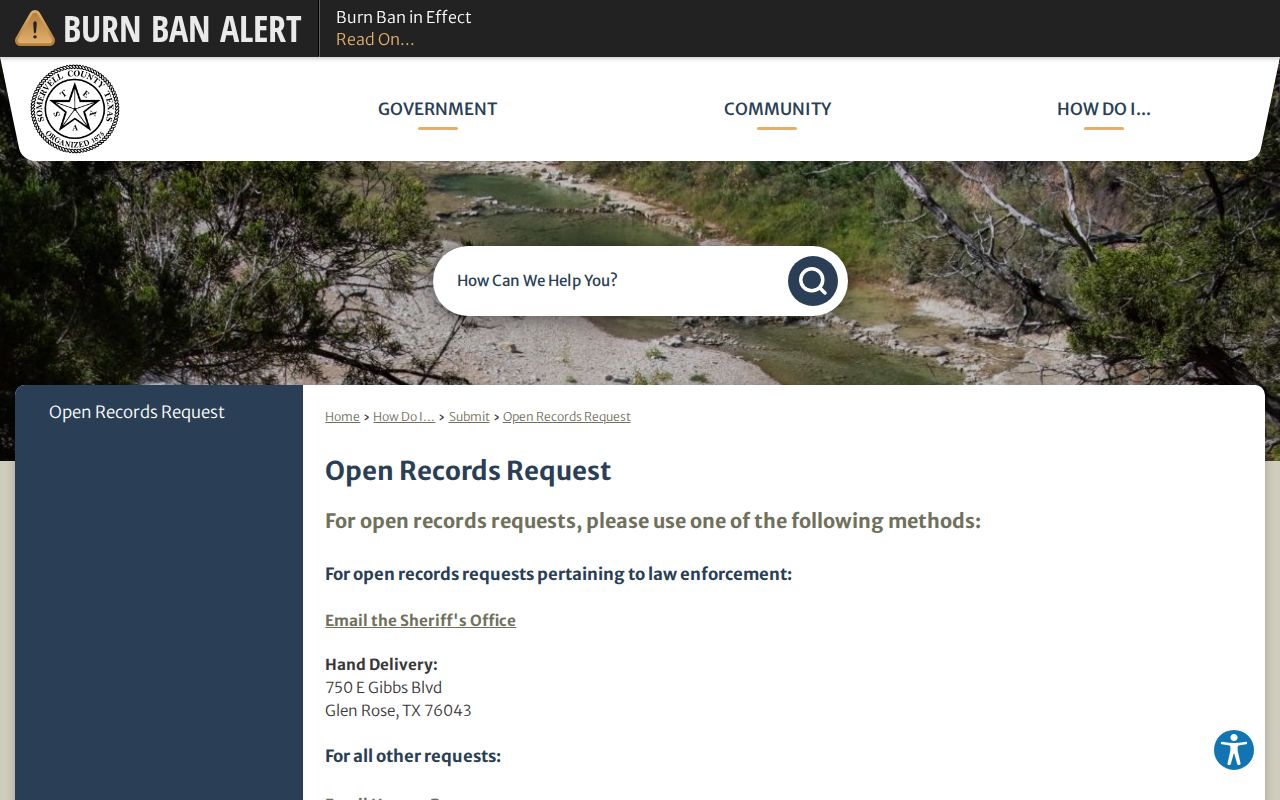
This formal channel preserves the exact period and requested fields, which a phone question may not.
Somervell 72-Hour Release Fields
Since no public list exists, these are fields to request rather than fields promised on a screen. A booking number and cause number help prevent same-name errors. The release basis matters because a log of jail exits can mix community releases with transfers.
| Field | Use within the 72-hour review |
|---|---|
| Person and booking identifier | Ties the exit to one county jail admission. |
| Booking timestamp | Separates repeated bookings for the same person. |
| Release or transfer timestamp | Tests whether the event falls inside the exact three-day range. |
| Disposition or authority | Provides the recorded basis for departure. |
| Charge, court, and cause | Points to the clerk holding the judgment or order. |
| Destination | Shows whether another jail, TDCJ, BOP, or ICE may hold the person. |
Ask for a booking photograph separately if it is needed to match identity. The sheriff may not store photos in the same export and need not build a photo-inclusive gallery. Disclosure exceptions can also be different for an image. Avoid extra personal data that does not help identify the booking.
Somervell Weekend Release Reconciliation
A three-day range helps when an overnight release crosses a calendar boundary. It also lets a Monday check include much of a weekend without assuming that staff published events each day. Still, no Somervell source states that releases follow a fixed weekday schedule, that holiday processing stops, or that records are entered at a set hour. Do not infer those details.
Match a jail exit to the court source responsible for the cause. The Somervell County Clerk handles county-level misdemeanor records, the District Clerk keeps permanent felony district files, and the Justice of the Peace handles Class C and magistrate matters. The Tyler UCMS public portal can help locate a case, but the cause number and court identify the actual custodian. A signed order explains the legal action; the sheriff timestamp shows when staff completed the jail exit.
A court dismissal on one charge may coexist with another hold. A bond order also does not prove the exact departure time. If the three-day results conflict with the docket, obtain both source records and ask the originating office to correct or explain its entry.
Widening the period should change the method, not just the dates. Sort the response by actual release or transfer timestamp. Then group repeated names by booking number and cause. A person may leave, return on a new warrant, or have more than one cause resolved during the same range. Counting names alone can therefore merge distinct custody events. The booking identifier keeps the three-day review tied to the right admission.
For each day, note whether an event occurred overnight or was entered on a later report date. That comparison reveals why a same-day inquiry may have missed it without accusing the source of error. Somervell publishes no cadence against which to judge a delay. The retained record and its correction history are the proper basis for resolving the sequence.
Note: no official Somervell rule promises a weekend update, holiday release adjustment, or immediate record production.
Classify Somervell Release Destinations
Every exit should be assigned to the correct path. A person may post bond, complete a local sentence, or leave under a court order. The same person may instead move to TDCJ after conviction, another county on a warrant, federal custody, or immigration custody. Only the first group may reflect release into the community.
| Recorded event | How to follow it |
|---|---|
| Bond or court-ordered community release | Confirm the sheriff timestamp and read the corresponding court docket. |
| County sentence completion | Compare the jail release authorization with judgment and jail-credit notation. |
| Transfer to TDCJ | Use the TDCJ offender search after acceptance into state custody. |
| Another county or authority | Check the receiving agency with the destination shown in the Somervell record. |
| Federal or ICE movement | Use BOP, the federal case, or ICE locator channels within their stated scope. |
Texas IVSS-Counties may show a county custody change and allow notification registration where a participating feed supports it. It is not a rolling list of every Somervell release. A portal miss can reflect a name mismatch, delay, moved custody, protected record, nonparticipation, or retention limit. Never treat the miss alone as proof that someone stayed or left.
For one named person, use the fuller Somervell released-inmate verification path. That process checks the jail event, court disposition, and the correct state or federal system.
Somervell Release Records Persist
The lack of a web archive does not erase the underlying record. Texas Local Schedule PS makes the county jail register permanent and requires it to include the date of release or transfer. Booking-in and booking-out documents, transfer records, and release-authorizing documents carry a minimum of release or transfer plus two years.
That permanent register is the distinctive Somervell fallback for a three-day check. It can preserve the core event after the requested period has passed. Retention does not override disclosure exceptions, force online publication, or guarantee a custom list. It simply identifies an existing durable category that is more useful than repeatedly searching for a feed the county never published.
Juvenile, sealed, expunged, private, active-investigation, and security-sensitive information may receive special treatment. Ask for the legal basis if a field is withheld. Use neutral labels and do not imply guilt from an old booking entry.
Release-authorizing documents can add detail beyond the permanent register. The register preserves the core date of release or transfer. A booking-out form, transport paper, commitment record, or release authorization may identify the authority and destination more clearly. Those related categories have a minimum two-year post-release or post-transfer schedule, but other holds can extend retention. Request the permanent entry first, then add the supporting document needed to answer why or where the person left.
Narrow Somervell Release Results
A three-day return may be too broad when the exact date is known. The Somervell released-last-24-hours method narrows the timestamps and adds same-day phone and alert checks. Both pages use the same custodian, but they answer different questions. The 72-hour approach reconstructs a wider span; the 24-hour approach seeks a recent, tightly bounded event.